
Startups operate in a unique environment where every hour counts, budgets are tight, and teams wear multiple hats. Effective time management isn't just about productivity—it's about survival. Knowing where your team's time goes determines whether you hit your runway targets, deliver products on schedule, and bill clients accurately enough to maintain cash flow.
But most time management tools are built for established enterprises with dedicated admin teams and generous budgets. Startups need lightweight, affordable solutions that scale from a 3-person founding team to a 50-person growth-stage company without requiring a project management consultant to configure.
This guide evaluates the 12 best time management tools for startups in 2025, with a focus on affordability, ease of setup, and the ability to grow with your company. For startups exploring automation specifically, understanding how to set up automated time tracking provides a practical starting point.
What Startups Need From Time Management Tools
Startup time management requirements differ significantly from enterprise needs:
Must-Have Features
- Quick Setup: Minutes to configure, not days of enterprise onboarding
- Low Per-User Cost: Pricing that doesn't punish team growth
- Client Billing Support: Many startups rely on consulting revenue alongside product development
- Flexible Project Structure: Support for both internal projects and client work
- Minimal Administrative Overhead: The tool should save time, not create new admin work
Nice-to-Have Features
- AI and Automation: Reduce manual tracking burden as the team scales
- GitHub Integration: Essential for tech startups with development-heavy workflows
- Multi-Currency Support: Important for startups with international clients or remote teams
- Reporting and Analytics: Data-driven insights into team productivity and project profitability
The 12 Best Time Management Tools for Startups
1. LogTime.ai — Best for Tech Startups Using GitHub
Why Startups Love It: Zero-effort time tracking that captures development activity automatically.
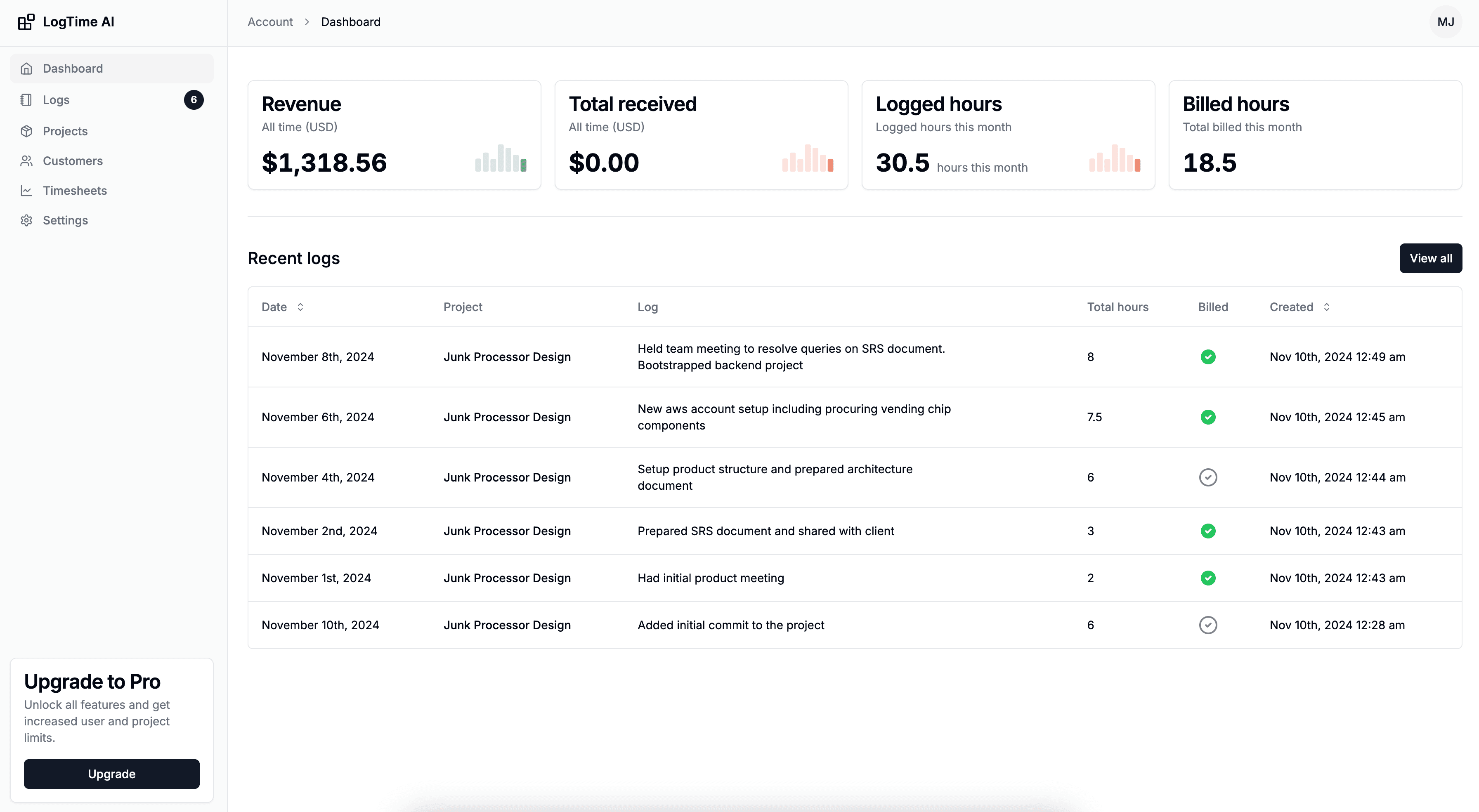
For tech startups where the founding team spends most of their time coding, LogTime.ai eliminates time tracking as a task entirely. GitHub commits automatically become time entries with AI-powered estimation and professional descriptions.
Startup-Friendly Features:
- Automated time capture from GitHub—no manual tracking
- AI-generated professional timesheets for client billing
- Multi-currency support for international clients and contractors
- Scales from solo founder to enterprise team
- 30-day free trial without credit card
Pricing: Starting at $9/month for 5 users and 10 projects.
Best For: Seed to Series A tech startups that use GitHub and need accurate time data for client billing, investor reporting, or internal productivity analysis.
2. Toggl Track — Best for Non-Technical Startup Teams
Why Startups Love It: Dead-simple interface that anyone can use immediately.
Toggl Track's strength is its simplicity. For startups with mixed technical and non-technical teams, Toggl provides a tracking experience that requires zero training.
Startup-Friendly Features:
- Free tier for up to 5 users
- One-click timer across all platforms
- 100+ integrations with popular tools
- Clean reporting dashboard
- Easy onboarding for new team members
Pricing: Free for 5 users, $9/user/month for Starter.
Best For: Early-stage startups with mixed teams where simplicity trumps advanced features.
3. Clockify — Best Free Option for Budget-Conscious Startups
Why Startups Love It: Unlimited free users for core time tracking features.
When every dollar matters, Clockify's free tier lets you track time across your entire team without any cost. It's the most budget-friendly entry point for startup time management.
Startup-Friendly Features:
- Unlimited free users for basic tracking
- Timer and manual entry options
- Project and client organization
- Basic reporting and exports
- Kiosk mode for shared spaces
Pricing: Free for unlimited users, paid features from $3.99/user/month.
Best For: Pre-revenue startups that need basic time tracking without any budget allocation.
4. Notion — Best for All-in-One Startup Workspace
Why Startups Love It: Combines project management, documentation, and basic time tracking in one tool.
Many startups already use Notion as their knowledge base and project management hub. While its time tracking capabilities are limited natively, combined with templates and integrations, it serves as a lightweight time management solution.
Startup-Friendly Features:
- Free for small teams
- Customizable databases for time tracking
- Combined with project management and documentation
- Template marketplace for time tracking setups
- API for custom integrations
Pricing: Free for small teams, $8/user/month for Plus.
Best For: Startups already using Notion that want basic time awareness without adding another tool.
5. Harvest — Best for Startups Billing Clients
Why Startups Love It: Native invoicing turns tracked time into client bills.
For startups that fund development through consulting or client services, Harvest's integrated invoicing workflow transforms time tracking data directly into professional invoices.
Startup-Friendly Features:
- Built-in invoicing from tracked hours
- Expense tracking alongside time
- Integration with QuickBooks and Xero
- Visual budget monitoring
- Team capacity planning
Pricing: Free for 1 user/2 projects, $10.80/user/month.
Best For: Service-based startups and agencies that need billing functionality alongside time tracking.
6. Linear — Best for Product-Focused Startup Teams
Why Startups Love It: Modern project management with cycle-based time awareness.
Linear has become the preferred issue tracker for startup engineering teams. While not a dedicated time tracker, its cycle-based approach provides natural time boundaries for measuring team velocity.
Startup-Friendly Features:
- Fast, keyboard-driven issue management
- Cycle-based planning with velocity tracking
- GitHub and GitLab integration
- Clean API for custom integrations
- Startup-friendly pricing
Pricing: Free for small teams, $8/user/month for Standard.
Best For: Product-focused startups that need development velocity tracking more than billable hour management.
7. Asana — Best for Cross-Functional Startup Teams
Why Startups Love It: Broad project management with time tracking through integrations.
Asana serves startups with cross-functional teams (engineering, marketing, sales, operations) by providing project management with time tracking available through integrations.
Startup-Friendly Features:
- Free tier for up to 15 users
- Multiple project views (list, board, timeline)
- Time tracking via Everhour or Toggl integrations
- Workflow automation
- Goal tracking and reporting
Pricing: Free for up to 15 users, $10.99/user/month for Starter.
Best For: Startups with 10-50 people across multiple departments needing coordinated project management.
8. Hubstaff — Best for Remote-First Startups Needing Accountability
Why Startups Love It: Provides visibility into distributed team activity with automated payments.
For remote-first startups working with contractors or distributed teams, Hubstaff offers activity tracking with integrated payment processing.
Startup-Friendly Features:
- Activity tracking for remote teams
- Automated payment processing
- Budget and limit setting per project
- GPS tracking for mobile team members
- Integration with project management tools
Pricing: Starting at $4.99/user/month.
Best For: Remote-first startups with contractor teams needing activity verification and automated payments.
9. Forest — Best for Individual Founder Focus
Why Startups Love It: Gamified focus sessions that help founders stay productive.
Solo founders and small founding teams often struggle with focus and time allocation across too many priorities. Forest gamifies focused work sessions to build better work habits.
Startup-Friendly Features:
- Pomodoro-style focus sessions
- Gamification with virtual trees
- Group planting for team focus sessions
- Distraction blocking
- Work history and statistics
Pricing: Free (basic), $3.99 one-time purchase.
Best For: Solo founders and very early-stage teams working on building focused work habits.
10. RescueTime — Best for Startup Founder Self-Awareness
Why Startups Love It: Automatic activity tracking reveals how founders actually spend time.
Startup founders often overestimate time spent on high-value activities. RescueTime runs passively in the background and provides an honest assessment of where time actually goes.
Startup-Friendly Features:
- Passive background activity tracking
- Automatic productivity categorization
- Focus time goals and tracking
- Distraction alerts
- Weekly productivity reports
Pricing: Free (basic), $12/month (Premium).
Best For: Founders who want to understand and optimize their personal time allocation without manual tracking.
11. Everhour — Best for Startups Using Multiple PM Tools
Why Startups Love It: Integrates with Asana, Jira, Trello, and Basecamp for in-tool time tracking.
Startups that use different project management tools across teams benefit from Everhour's ability to add time tracking directly within those platforms.
Startup-Friendly Features:
- Native integration with major PM tools
- In-app time tracking widgets
- Budget tracking and alerts
- Team resource planning
- Client billing reports
Pricing: Free for up to 5 users, $8.50/user/month for teams.
Best For: Startups using Asana, Jira, or Trello that want embedded time tracking without switching tools.
12. Tempo Timesheets — Best for Startups Using Jira
Why Startups Love It: Enhanced time tracking within the Jira ecosystem.
For startups that have invested in Jira for project management, Tempo enhances native time tracking with better reporting, approvals, and capacity planning.
Startup-Friendly Features:
- Native Jira integration
- Timesheet approval workflows
- Capacity planning
- Financial reporting
- Team workload management
Pricing: Starting at $10/user/month.
Best For: Startups heavily invested in the Atlassian ecosystem that need enhanced time tracking within Jira.
Quick Comparison for Startups
| Tool | Free Tier | Best For | Setup Time | Automation |
|---|---|---|---|---|
| LogTime.ai | 30-day trial | GitHub dev teams | 15 min | Full AI |
| Toggl Track | 5 users | Simple tracking | 5 min | None |
| Clockify | Unlimited | Budget teams | 10 min | Basic |
| Notion | Small teams | All-in-one workspace | 30 min | None |
| Harvest | 1 user | Client billing | 15 min | None |
| Linear | Small teams | Issue tracking | 20 min | None |
| Asana | 15 users | Cross-functional | 30 min | Via integrations |
| Hubstaff | 14-day trial | Remote monitoring | 20 min | Activity |
| Forest | Basic features | Focus sessions | 2 min | None |
| RescueTime | Basic features | Self-awareness | 5 min | Full passive |
| Everhour | 5 users | PM integrations | 15 min | None |
| Tempo | Trial | Jira enhancement | 30 min | None |
How to Choose: Startup Stage Guide
Pre-Seed / Solo Founder
Start with Clockify (free) or RescueTime (free) for basic awareness. Add LogTime.ai when you start billing clients for development work.
Seed Stage (2-10 People)
LogTime.ai if you're a tech startup using GitHub. Toggl Track or Harvest if you need broader team tracking with client billing.
Series A (10-50 People)
LogTime.ai for development team tracking combined with Asana or Linear for cross-functional project management. Consider Harvest for integrated invoicing.
Growth Stage (50+ People)
Enterprise-ready solutions like LogTime.ai Enterprise, Tempo, or a combination of tools with centralized reporting. Automation becomes critical at this scale to prevent administrative overhead from growing with headcount.
Conclusion
The right time management tool for your startup depends on your stage, team composition, and primary workflow. Tech startups using GitHub get the most value from LogTime.ai's automated approach, while mixed teams might start with Toggl or Clockify and evolve their tooling as they grow.
The key principle is this: time spent managing time tracking is time not spent building your product. Choose the tool that minimizes overhead while giving you the visibility you need to make smart decisions about resource allocation and client billing.
Ready to automate time tracking for your startup? Start your free LogTime.ai trial and focus your team's energy on building, not tracking.
Building a startup and need advice on time management tooling? Reach out at support@logtime.ai—we love helping early-stage teams.